Key takeaways:
Nerve flossing, or neural gliding, stretches nerves so they move more freely.
Sciatic nerve flossing can help reduce compression of the sciatic nerve and provide relief from sciatica, especially if performed every day.
You may need other medical treatments if your sciatica is caused by lower-back problems. Examples include physical therapy, injections, or surgery.
Flossing might not be at the top of your list of treatments for sciatica. But nerve flossing may help ease your symptoms. It’s a stretching technique that mobilizes nerves. These stretching exercises may help relieve nerve compression and reduce pain from an irritated or pinched nerve.
Nerve flossing targets long nerves that extend from the spine to the arms or legs. It can be used to treat conditions such as sciatica, carpal tunnel syndrome, and cervical radiculopathy (pinched nerve). Nerve flossing for sciatica involves moving and stretching your lower back, legs, and ankles. Here's what you need to know.
What is nerve flossing for sciatica?
Flosses and stretches for the sciatic nerve are some of the best exercises for sciatica. The sciatic nerve is the longest nerve in the body. It travels from the spine, down the back of the leg, and into the foot. Nerve flossing exercises stretch the sciatic nerve at different points along its path.
Search and compare options
Sciatic nerve flossing frees up the nerve, allowing it to glide when your joints and muscles move. That's why the exercises are also called sciatic nerve glides. Freeing up the nerve helps reduce sciatic nerve compression symptoms in the lower back and leg and reduce disability.
Keep in mind that it’s best to ease into nerve flossing for sciatica. Too much tension or stretching along a nerve can be harmful and cause more irritation. You should feel tension or a pulling sensation but not a significant increase in pain.
What are the best neural gliding exercises for sciatica?
Nerve flossing, or neural gliding, can be performed in various ways. Some variations can stretch just one point along the nerve, while others place maximal stretch along the entire nerve.
1. Seated sciatic nerve floss
This sciatic nerve gliding exercise alternates stretching and releasing the sciatic nerve. This allows for better mobility of the nerve as tension is applied along the very top and bottom of its path.
Step 1: Sit upright in a chair with both feet flat on the floor.
Step 2: Extend one leg out to fully straighten your knee. Keep your ankle, knee, and hip at the same level.
Step 3: At the same time, point your foot away from you as you bend your head down to bring your chin to your chest. Keep your knee extended the entire time.
Step 4: Now, reverse both of these motions. Flex your foot up toward you as you extend your head up toward the ceiling. Keep your knee extended the entire time.
Step 5: Alternate through steps 3 and 4, moving your foot and head together at the same time. Repeat 20 times in each direction.
2. Slump stretch
This move is similar to the last one, but it applies maximal stretch across the entire sciatic nerve. This variation is called the slump stretch since you’ll be sitting in a slumped-over position.
Step 1: Sit upright in a chair with both feet flat on the floor.
Step 2: Extend one leg out to fully straighten your knee. Keep your ankle, knee, and hip at the same level.
Step 3: Keeping your knee extended, flex your foot up toward you.
Step 4: Bend your head down to bring your chin to your chest.
Step 5: Round your body forward to move into a slumped position.
Step 6: Hold this position for 5 seconds. Then relax and return to the starting position.
Step 7: Repeat 20 times.
3. Straight leg raise sciatic nerve stretch (supine sciatic nerve floss)
This move stretches the sciatic nerve at all points along its path from the low back to the ankle.
Studies suggest that this technique, like the slump stretch, can help reduce pain and improve function.
Step 1: Lie on your back with your knees bent and feet flat.
Step 2: Extend one leg out to fully straighten your knee and flex your foot up toward your shin.
Step 3: Keeping your knee extended and ankle flexed, lift your leg up as high as you can until you feel a stretch behind the back of your leg.
Step 4: Hold the stretch for 5 seconds. Then relax your leg back down to the starting position.
Step 5: Repeat 20 times.

Read more like this
Explore these related articles, suggested for readers like you.




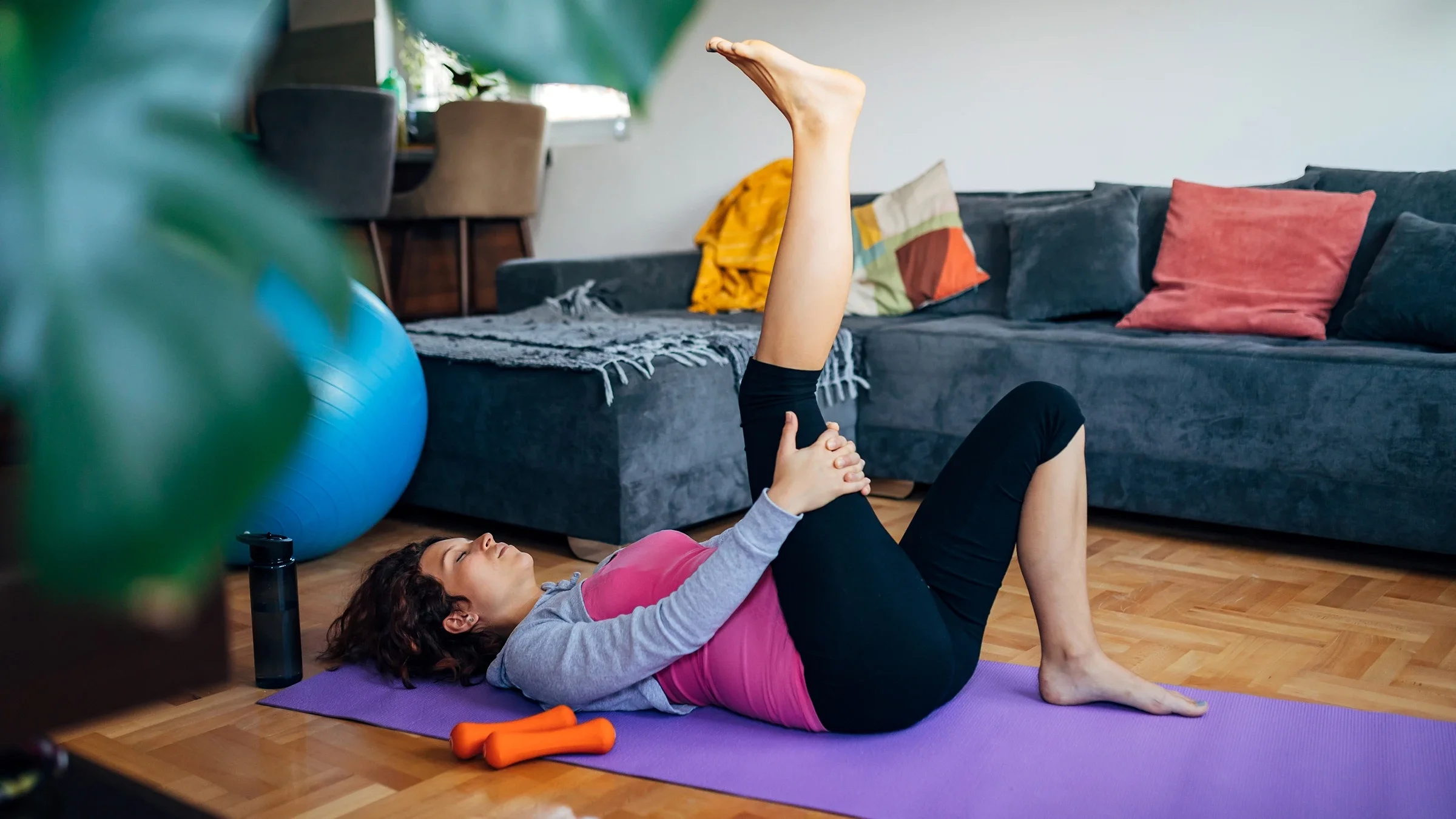
4. Knee-to-chest sciatic nerve floss
This supine sciatic nerve floss variation helps move the sciatic nerve throughout the lower leg. Because your back will stay flat, this exercise places less tension on the entire nerve. This can be a more comfortable option if the other variations apply too much tension.
Step 1: Lie on your back with your knees bent and feet flat.
Step 2: Lift one leg to bring your knee closer to your chest. Grab behind your thigh with both hands.
Step 3: While holding your thigh, straighten your knee as much as you can to bring your foot up toward the ceiling.
Step 4: With your leg extended, flex your foot up toward your shin.
Step 5: Hold this position for 5 seconds. Then relax and return to the starting position.
Step 6: Repeat 20 times.
5. Standing sciatic nerve floss
Like the seated version, this technique stretches and releases the sciatic nerve at different points along its path. This helps reduce tension and allows the nerve to glide smoothly.
Step 1: Stand in front of a step.
Step 2: Place your heel on the step. Straighten your knee to keep your leg straight and lean forward.
Step 3: At the same time, point your foot away from you as you bend your head down to bring your chin to your chest. Keep your knee extended the entire time.
Step 4: Now, reverse both of these motions. Flex your foot up toward you as you extend your head up toward the ceiling. Keep your knee extended the entire time.
Step 5: Alternate through steps 3 and 4, moving your foot and head together at the same time. Repeat 20 times in each direction.
How often should you do nerve flossing for sciatica?
For best results, do sciatic nerve flossing every day. Regular stretching can provide lasting relief for sciatic nerve compression and pain. If you still have pain after 6 weeks, talk with a healthcare professional.
Even though sciatic nerve flossing can help reduce nerve irritation, it may not be enough to fix the root of the issue. Conditions that affect the low back, such as herniated discs or spinal stenosis, can compress the sciatic nerve at its origin in the low back. If you don’t treat these conditions properly, sciatic nerve irritation and pain can continue, even with daily nerve flossing.
Sometimes, physical therapy and targeted exercises can provide lasting relief from sciatica. In more chronic cases, injections or surgery may be needed to relieve sciatic nerve compression.
Are there any risks with nerve flossing?
In general, nerve flossing is safe and can improve pain and disability in people with sciatica. Nerve flossing can be more risky soon after injury or surgery. As with any other exercise, stop nerve flossing exercises and seek care if:
Your pain worsens or persists
You develop weakness
You develop bowel or bladder problems
Frequently asked questions
Vitamin deficiencies can affect the functioning of nerves and lead to neuropathy. This is especially the case with low levels of:
Vitamin B1
Vitamin B9 (folic acid)
Vitamin B12
Vitamin E
Peripheral neuropathy can affect various nerves and may cause leg pain. The nerve damage from peripheral neuropathy can also make nerve compression and entrapment more likely. Keep in mind that vitamin levels that are too high can cause neuropathy as well — as is the case with excess vitamin B6.
Staying in bed for too long is one of the worst things you can do for sciatica. People with sciatica are advised to stay active as a part of their treatment plan.
In addition to that, anything that puts too much pressure on your spine can aggravate or increase the risk of sciatica. Your symptoms can be worsened by:
Heavy lifting
Prolonged sitting or standing
Repetitive bending
Poor sleep posture may worsen low back pain. Lying on your stomach (prone sleeping) is believed to cause added pressure, which can increase your risk of spine pain when waking up. The most comfortable sleeping position will be different for everyone. To ease pressure on your sciatic nerve, you may want to try sleeping on your side with a pillow between your knees.
Vitamin deficiencies can affect the functioning of nerves and lead to neuropathy. This is especially the case with low levels of:
Vitamin B1
Vitamin B9 (folic acid)
Vitamin B12
Vitamin E
Peripheral neuropathy can affect various nerves and may cause leg pain. The nerve damage from peripheral neuropathy can also make nerve compression and entrapment more likely. Keep in mind that vitamin levels that are too high can cause neuropathy as well — as is the case with excess vitamin B6.
Staying in bed for too long is one of the worst things you can do for sciatica. People with sciatica are advised to stay active as a part of their treatment plan.
In addition to that, anything that puts too much pressure on your spine can aggravate or increase the risk of sciatica. Your symptoms can be worsened by:
Heavy lifting
Prolonged sitting or standing
Repetitive bending
Poor sleep posture may worsen low back pain. Lying on your stomach (prone sleeping) is believed to cause added pressure, which can increase your risk of spine pain when waking up. The most comfortable sleeping position will be different for everyone. To ease pressure on your sciatic nerve, you may want to try sleeping on your side with a pillow between your knees.
The bottom line
Nerve flossing is a type of exercise that stretches and mobilizes a nerve. Nerve flossing is particularly helpful for the sciatic nerve that travels from the low back down the leg. Stretching the sciatic nerve can help reduce compression to allow the nerve to move more freely.
Try sciatic nerve flossing every day for a few weeks. If you don’t have any relief from sciatica, talk with a healthcare professional. You may need more treatment to address ongoing sciatic nerve compression.

Why trust our experts?




References
Alshami, A. M., et al. (2021). Effect of neural mobilization exercises in patients with low back-related leg pain with peripheral nerve sensitization: A prospective, controlled trial. Journal of Chiropractic Medicine.
Berg, E. (2022). Say goodbye to sciatica pain: 3 simple stretches that work [video]. YouTube.
Cary, D., et al. (2019). Identifying relationships between sleep posture and non-specific spinal symptoms in adults: A scoping review. BMJ Open.
Chin, R. L., et al. (2017). Management of nutritional and toxic neuropathies. Massachusetts General Hospital.
Corrêa, L. A., et al. (2022). Neural management plus advice to stay active on clinical measures and sciatic neurodynamic for patients with chronic sciatica: Study protocol for a controlled randomised clinical trial. PLOS One.
Ellis, R. F., et al. (2008). Neural mobilization: A systematic review of randomized controlled trials with an analysis of therapeutic efficacy. The Journal of Manual & Manipulative Therapy.
Fairag, M., et al. (2022). Risk factors, prevention, and primary and secondary management of sciatica: An updated overview. Cureus.
Henrique, H., et al. (2015). Neurodynamic mobilization and peripheral nerve regeneration: A narrative review. International Journal of Neurorehabilitation.
Jeong, U. C., et al. (2016). The effects of self-mobilization techniques for the sciatic nerves on physical functions and health of low back pain patients with lower limb radiating pain. Journal of Physical Therapy Science.
Journal of Orthopaedic & Sports Physical Therapy. (2017). Neural mobilization: Treating nerve-related musculoskeletal conditions.
Journal of Orthopaedic & Sports Physical Therapy. (2017). The effectiveness of neural mobilization for neuromusculoskeletal conditions: A systematic review and meta-analysis.
Lin, L. H., et al. (2023). Neural mobilization for reducing pain and disability in patients with lumbar radiculopathy: A systematic review and meta-analysis. Life (Basel, Switzerland).
Muhamad, R., et al. (2023). The role of vitamin b6 in peripheral neuropathy: A systematic review. Nutrients.
National Institute of Arthritis and Musculoskeletal and Skin Diseases. (2023). Spinal stenosis basics.
Peacock, M., et al. (2023). Neural mobilization in low back and radicular pain: A systematic review. The Journal of Manual & Manipulative Therapy.
Rehab My Patient. (2014). Sciatic nerve glide floss 3 [video]. YouTube.
Rehab My Patient. (2014). Sciatic nerve stretch 1 Slump stretch [video]. YouTube.
Rota, E., et al. (2016). Entrapment neuropathies in diabetes mellitus. World Journal of Diabetes.
Streamline Performance Physical Therapy. (2020). Standing sciatic nerve glide [video]. YouTube.