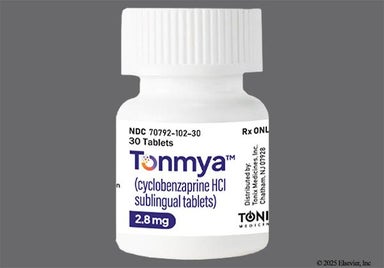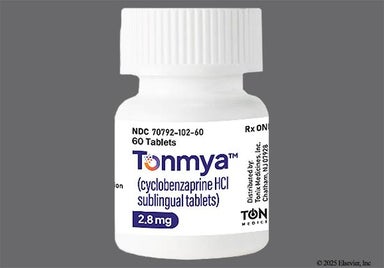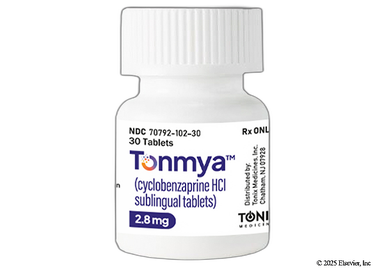
Tonmya
Tonmya (cyclobenzaprine) is a muscle relaxant for adults with fibromyalgia. It comes as a small tablet that you place under your tongue at bedtime, once each night. Common effects include mouth numbness or tingling, sleepiness, and a strange taste in your mouth. Tonmya (cyclobenzaprine) isn’t a controlled substance.


What is Tonmya (cyclobenzaprine)?
What is Tonmya (cyclobenzaprine) used for?
- Fibromyalgia in adults
How Tonmya (cyclobenzaprine) works
Tonmya (cyclobenzaprine) is a muscle relaxant. Experts aren’t exactly sure how it helps fibromyalgia, but it affects certain signals in your brain and body that are linked to pain and muscle tension. This can help improve your sleep and reduce pain over time.
Drug facts
| Common Brands | Tonmya |
|---|---|
| Drug Class | Muscle relaxant |
| Controlled Substance Classification | Not a controlled medication |
| Generic Status | No lower-cost generic available |
| Availability | Prescription only |

Side effects of Tonmya (cyclobenzaprine)
The following side effects may get better over time as your body gets used to the medication. Let your healthcare provider know immediately if you continue to experience these symptoms or if they worsen over time.
Common Side Effects
- Numbness in the mouth (23%)
- Discomfort in the mouth (9%)
- Abnormal taste (9%)
- Sleepiness (6%)
- Tingling in the mouth (6%)
- Mouth pain (5%)
Less Common Side Effects
- Feeling tired
- Dry mouth or throat
- Canker sore
Tonmya (cyclobenzaprine) serious side effects
Contact your healthcare provider immediately if you experience any of the following.
- Allergic reaction: trouble breathing, hives, swelling of your face or tongue, severe rash
- Serotonin syndrome: confusion, agitation, sweating or fever, stiff or twitching muscles, shivering, fast heartbeat, diarrhea, high blood pressure
- Heart attack or stroke: fast or irregular heartbeat, chest pain, dizziness, fainting, shortness of breath
- Severe mouth reactions: painful sores, swelling, pain that makes it hard to eat/drink/swallow/breathe
The following Tonmya (cyclobenzaprine) side effects have also been reported
Side effects that you should report to your care team as soon as possible:
- Allergic reactions—skin rash, itching, hives, swelling of the face, lips, tongue, or throat
- CNS depression—slow or shallow breathing, shortness of breath, feeling faint, dizziness, confusion, trouble staying awake
- Heart rhythm changes—fast or irregular heartbeat, dizziness, feeling faint or lightheaded, chest pain, trouble breathing
- Pain, redness, or swelling with sores inside the mouth or throat
Side effects that usually do not require medical attention (report these to your care team if they continue or are bothersome):
- Numbness or tingling of the tongue or mouth
- Dry mouth
- Drowsiness

Get your GoodRx coupon

Pros and cons of Tonmya (cyclobenzaprine)
Pros
- Only taken once nightly
- Can improve sleep quality while helping with fibromyalgia pain
- Not a controlled substance
Cons
- Mouth numbness or taste changes are common
- Can interact with many medications
- Not safe for certain heart conditions

Pharmacist tips for Tonmya (cyclobenzaprine)

- Take Tonmya (cyclobenzaprine) at bedtime at the same time each night, after brushing your teeth. This helps improve sleep and lowers daytime drowsiness.
- Take a few sips of water before taking Tonmya (cyclobenzaprine). A moist mouth helps the tablet dissolve under your tongue and might reduce mouth side effects.
- Place Tonmya (cyclobenzaprine) under your tongue and let it fully dissolve. Don’t swallow, chew, or crush it so it can work the right way.
- Don’t eat or drink for at least 15 minutes after Tonmya (cyclobenzaprine) dissolves. Try to avoid hot, cold, or acidic drinks until morning.
- Try not to talk for about 5 minutes after taking Tonmya (cyclobenzaprine). This helps the tablet stay in place while it dissolves.
- You might notice numbness, tingling, or a strange taste after taking Tonmya (cyclobenzaprine). These effects are common and usually go away within an hour. But tell your care team if symptoms are severe or don’t improve.
- Tonmya (cyclobenzaprine) can make you sleepy. Wait to drive or use machinery until you know how the medication affects you.
- Tell your care team about all medications and supplements you take before using Tonmya (cyclobenzaprine). Some medications, like certain antidepressants, opioids, and migraine medications can raise your risk of serotonin syndrome or other problems.
- Don’t take Tonmya (cyclobenzaprine) with monoamine oxidase inhibitors (MAOIs) or within 14 days of stopping one. This combination can be life-threatening.
- Avoid alcohol while taking Tonmya (cyclobenzaprine), since the combination can make you very sleepy, dizzy, and slow your breathing.
- If you miss a dose of Tonmya (cyclobenzaprine), take your next dose the following evening. Don’t take an extra dose during the day.
- Pregnancy: Tell your care team if you’re pregnant or planning to become pregnant while taking Tonmya (cyclobenzaprine) since it can harm an unborn baby. Use birth control during treatment and for 2 weeks after your last dose.
- Storage: Store Tonmya (cyclobenzaprine) in its original bottle at room temperature. Keep it dry and leave the desiccant in the bottle to protect the tablets.

Risks and warnings for Tonmya (cyclobenzaprine)
Tonmya (cyclobenzaprine) can cause some serious health issues. This risk may be even higher for certain groups. If this worries you, talk to your doctor or pharmacist about other options.
Harm to unborn babies
- Risk factors: Early pregnancy
Tonmya (cyclobenzaprine) might harm an unborn baby, especially early in pregnancy. This includes a higher risk of birth defects that affect the baby’s spine. Avoid taking Tonmya (cyclobenzaprine) starting 2 weeks before trying to get pregnant and during the first trimester. Your care team might check for pregnancy before you start treatment.
Use reliable birth control while taking Tonmya (cyclobenzaprine) and for 2 weeks after your last dose. If you become pregnant, tell your care team right away and report it to Tonix Medicines, Inc. at 1-888-869-7633 (1-888-TNXPMED).
Serotonin syndrome
- Risk factors: Taking other medications that can affect the serotonin levels in your brain
It's rare, but some people have had a serious and potentially life-threatening condition called serotonin syndrome when taking Tonmya (cyclobenzaprine) with certain medications that raise serotonin levels in the brain. These include some antidepressants and opioid pain medications. Tell your prescriber and pharmacist about all the medications you take so they can check your risk.
Watch for symptoms like a fast heart rate, sweating, muscle stiffness or spasms, fever, or confusion. Get medical help right away if you notice any of these symptoms.
Tricyclic antidepressant‑like side effects
- Risk factors: History of seizures | History of certain heart problems
Cyclobenzaprine (the active ingredient in Tonmya (cyclobenzaprine)), is related to tricyclic antidepressants (TCAs), which have been linked to heart rhythm problems, heart attack, and stroke. These medications can also lower the seizure threshold, making seizures more likely in some people.
Get medical help right away if you have chest pain, shortness of breath, severe dizziness, fainting, or stroke-like symptoms. Tell your care team if you have a history of seizures so they can decide if this medication is safe for you or monitor you more closely.
Caution use in people with glaucoma or trouble urinating
- Risk factors: History of glaucoma or high eye pressure | History of trouble urinating
Before starting Tonmya (cyclobenzaprine), talk to your prescriber if you have glaucoma, high eye pressure, or trouble urinating. This medication can make these problems worse. Your prescriber can help decide if it's safe for you and might monitor you more closely during treatment.
Drowsiness and slowed thinking
- Risk factors: Drinking alcohol | Taking other medications that cause drowsiness | Over 65 years old
Tonmya (cyclobenzaprine) can make you feel sleepy and slow your reaction time. It can also make it harder to focus. These side effects are more likely to happen if you're over 65 years old or take other medications that cause drowsiness.
Avoid driving, using machines, or doing tasks that need focus until you know how Tonmya (cyclobenzaprine) affects you. Don't drink alcohol while taking this medication since it can make these side effects worse. Talk to your prescriber if these side effects bother you or make daily activities hard.
Mouth side effects
Mouth numbness, tingling, discomfort, irritation, sores, or pain can happen with Tonmya (cyclobenzaprine). They usually start within minutes after dosing. Most are mild and last less than an hour, but some can be more severe and affect a larger area of your mouth.
Take a few sips of water before using Tonmya (cyclobenzaprine) to help reduce numbness, and avoid eating or drinking for 15 minutes after. Tell your care team if you have severe pain, large areas of irritation, or trouble eating, drinking, or swallowing. They might tell you to stop the medication.

Tonmya (cyclobenzaprine) dosage
 Sublingual tablet
| Dosage | Quantity | Price as low as | Price per unit |
|---|---|---|---|
| 2.8mg of | 60 sublingual tablets | $0.00 | $0.00 |
Typical dosage for Tonmya (cyclobenzaprine)
The typical starting dose is 2.8 mg dissolved under your tongue nightly at bedtime for 14 days. Then, your prescriber will raise your dose to 5.6 mg dissolved under the tongue each night. The maximum recommended dose is 5.6 mg nightly.
Your dose might differ if you’re older or have liver problems.

How much does Tonmya (cyclobenzaprine) cost?
$0.00
0
Tonmya (cyclobenzaprine) contraindications
Contraindications are specific health conditions or situations in which a person should not take a medication due to safety concerns. If you have any of the following conditions or if any of the following apply to you, let your healthcare provider know because Tonmya (cyclobenzaprine) will not be safe for you to take.
- Past allergy to cyclobenzaprine
- Currently take or have taken a monoamine oxidase inhibitor (MAOI) within the past 14 days
- Recent heart attack
- Abnormal heart rhythm (arrhythmias) or heart block
- Heart failure
- Hyperthyroidism (overactive thyroid)

What are alternatives to Tonmya (cyclobenzaprine)?

Tonmya (cyclobenzaprine) images